
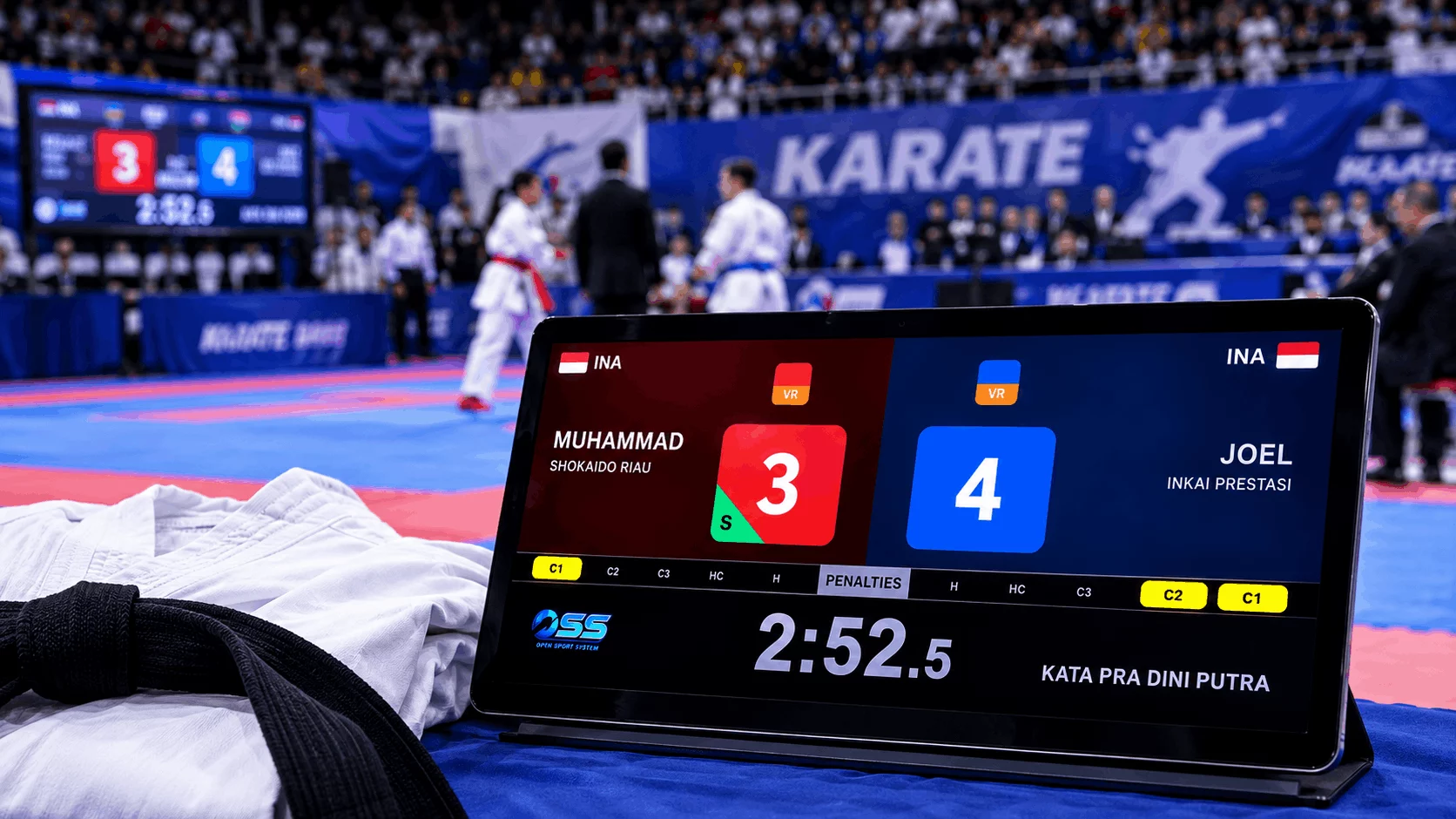
A Karate Tournament Software Scoring System eliminates bracket delays, scoring disputes, and manual errors. This guide covers features, pricing, and why OSS keeps events running on time.
- Manual bracket updates during a 300-athlete event can add 45-90 minutes of dead time.
- Scoring disputes are the number one cause of referee-coach conflict at regional tournaments.
- Cloud-based tournament platforms typically range from $500 to $3,000 per event, depending on scale.
A Karate Tournament Software Scoring System replaces paper brackets and manual scorekeeping with real-time digital control. It tracks matches, calculates points, and updates standings instantly, so your event never stalls.
You have 200 athletes, four tatami mats, and a gym that closes in six hours. The first bracket gets stuck because a coach disputes a score. The referee calls for the head table. Nobody can find the updated sheet. Meanwhile, 40 kids are sitting on the floor, parents are checking their watches, and the venue manager is already walking toward you with that look.
That scene plays out at tournaments everywhere. Not because organizers are careless. Because paper and spreadsheets cannot keep pace with a live event. A proper Karate Tournament Software Scoring System fixes that. Not with magic. With structure.
📑 Daftar Isi
- Why Manual Scoring Fails Under Pressure
- What a Modern Karate Tournament Software Scoring System Actually Does
- The Real Cost of Getting This Wrong
- Pricing: What You Should Expect to Pay
- Features That Separate Good Systems from Bad Ones
- How to Evaluate a Platform Before You Buy
- Implementation: What the First Event Looks Like
- Why OSS Stands Out
- Final Thoughts: Stop Fighting the System
- FAQ
Why Manual Scoring Fails Under Pressure
Let me be blunt. Paper brackets work fine until they don’t. The moment you run more than two mats simultaneously, things break down.
Here is what typically goes wrong:
- Score disputes drag on. A referee signals a point. The scorekeeper writes it down. A coach objects. Now you are re-checking three sheets to verify what actually happened.
- Bracket updates lag. A winner advances, but the next match card is not ready. The ring sits idle for 10-15 minutes. Multiply that by every division.
- Standings become unreliable. By midday, your master sheet has cross-outs, corrections, and coffee stains. Nobody trusts it.
Based on our field experience running regional and national events, the average delay per disputed match is 8 to 12 minutes. At a 300-athlete tournament with 15 divisions, that adds up to hours of lost time. Athletes get cold. Parents get frustrated. Referees get blamed for something that is really a systems problem.
What a Modern Karate Tournament Software Scoring System Actually Does
A digital scoring system is not just a scoreboard on a screen. It is the operational backbone of your event. Here is what separates a functional platform from a glorified spreadsheet.
Real-Time Bracket Management
When a match ends, the winner advances automatically. No manual card sorting. No “wait, who won kata division 7?” moments. The bracket updates the second a referee confirms the result.
Digital Score Capture
Referees input points directly through a tablet, phone, or dedicated scoring device. The system logs every action with a timestamp. If a coach disputes a call, you pull up the exact sequence. End of argument.
Instant Standings and Medal Tracking
Team standings, individual rankings, and medal counts refresh automatically. Announcers can read results immediately. No waiting for the head table to tally points on a calculator.
Multi-Mat Coordination
Run four, six, or eight mats from one dashboard. Assign referees, rotate judges, and monitor match flow across the entire venue. One person can oversee everything from a laptop.
If you want a deeper walkthrough of how these systems fit into event operations, read our Karate Tournament Software: The Practical Guide to Running Smarter Events.
The Real Cost of Getting This Wrong
Let me share something from personal experience. Before we started using Karate Tournament Software, we constantly argued with coaches and referees. Brackets were never finished on time. Scoring disputes turned into shouting matches at the head table. It was embarrassing. We were losing credibility with the very people who trusted us to run a fair event.
That changed when we moved to a proper digital platform. Not because the software is magic. Because it removed the ambiguity that caused those fights in the first place.
Here is a comparison worth studying:
| Factor | Manual System | Digital Karate Tournament Software Scoring System |
|---|---|---|
| Bracket update time | 5-15 minutes per match | Instant |
| Score dispute resolution | Manual review, 10+ minutes | Timestamped digital log, under 2 minutes |
| Standings accuracy | Prone to human error | Automatic calculation |
| Multi-mat coordination | Requires 2-3 head table staff | One operator manages all mats |
| Post-event reporting | Hours of manual tallying | Export in minutes |
The difference is not incremental. It is structural.
Pricing: What You Should Expect to Pay
Search intent here is clear. You want to know what this costs before you commit. Fair enough.
A Karate Tournament Software Scoring System generally falls into three pricing tiers:
- Basic (single event license): $300 to $800 per tournament. Covers bracket management, basic scoring, and one-mat operation.
- Standard (multi-mat license): $800 to $1,800 per event. Includes multi-mat coordination, digital score entry, and real-time standings.
- Enterprise (annual or federation license): $2,500 to $6,000+ per year. Unlimited events, custom branding, API access, and dedicated support.
Some platforms charge per athlete. That model gets expensive fast. A 500-athlete tournament at $3 per head adds $1,500 before you even open the doors. Flat-rate licensing is usually the smarter path for recurring events.
OSS: All in #1 Karate Tournament Software offers flexible plans that scale with your event size. You are not paying for features you will never use.
Features That Separate Good Systems from Bad Ones
Not every platform is built for karate. Some are generic tournament tools adapted from other sports. That matters.
Karate-Specific Scoring Rules
Karate scoring is not the same as taekwondo or judo. You need support for karate competition rules, including yuko, waza-ari, and ippon. Flag systems for kata. Penalty tracking for hansoku. If the software does not understand your sport, you are forcing a square peg into a round hole.
Offline Capability
Venue Wi-Fi fails. It always does. A reliable system caches data locally and syncs when the connection returns. If your platform requires constant internet, you are one router reboot away from disaster.
Referee and Judge Rotation
Managing judge assignments across multiple mats is a logistical headache. Good software lets you set rotation schedules, track certifications, and avoid conflicts of interest automatically.
Live Display and Announcer Integration
Spectators want to see results. A digital display that pulls directly from the scoring system keeps everyone informed without constant announcements.
How to Evaluate a Platform Before You Buy
Practical tips from our team: do not buy based on a demo alone. Ask these questions.
- Can I run a test event with real data before committing?
- What happens when the internet goes down mid-match?
- How long does setup take for a 200-athlete tournament?
- Does the vendor provide on-site or remote support during the event?
- Can I export results in formats my federation requires?
If the vendor hesitates on any of these, walk away.
Implementation: What the First Event Looks Like
Switching from paper to digital is not painless. But it is manageable if you plan.
Step 1: Import your athlete roster and division structure. Most platforms accept CSV uploads.Step 2: Assign mats, referees, and judges in the system. Print backup cards just in case.Step 3: Run a 30-minute training session with your head table staff and referees. Show them how to enter scores and confirm results.Step 4: Go live. Keep one person dedicated to monitoring the dashboard and troubleshooting.Step 5: After the event, review the logs. Identify bottlenecks. Adjust for next time.
The second event is always smoother. By the third, you will wonder why you ever used paper.
Why OSS Stands Out
OSS: All in #1 Karate Tournament Software was built specifically for karate events. It handles the scoring nuances, bracket formats, and multi-mat coordination that generic platforms miss. The interface is designed for speed. Referees can enter results in seconds. Organizers can see the entire event status at a glance.
Support matters too. When you are running a live event and something breaks, you need someone who answers the phone. OSS provides real-time support during tournaments. Not a ticket system. Not an email queue. Actual help.
The platform also integrates with registration tools, so athlete data flows directly into brackets without manual entry. That alone saves hours of prep time.
Final Thoughts: Stop Fighting the System
Running a karate tournament is hard enough. You should not be fighting your own scoring tools. A Karate Tournament Software Scoring System gives you control, accuracy, and speed. It ends the arguments. It keeps matches moving. It protects your reputation as an organizer who runs a tight event.
The investment pays for itself in the first tournament. Not just in time saved, but in trust earned from coaches, referees, and parents who notice when things run right.
Your Next Tournament Deserves Better Than Paper Brackets
Stop losing time to score disputes and bracket delays. OSS: All in #1 Karate Tournament Software is ready to run your next event without the chaos.


1 Comment
Pingback: oss system: Solusi Panitia Karate, Bebas Ribet & Juara